Discovering Trentino: weekend getaway in San Candido Innichen
- The Editorial Office

- 22 feb 2023
- Tempo di lettura: 6 min
Aggiornamento: 23 feb 2023
San Candido Innichen (Bolzano); Region: Trentino Alto-Adige Alta Pusteria (Italy); Inhabitants: about 3365; Language: Italian and German.

In this guide we want to give you some suggestions to make the most of the suggestive winter landscape in Trentino: immerse yourself in nature, disconnect your thoughts and enjoy the paths and views to the fullest.
Some suggestions for San Candido Innichen and surroundings.
San Candido is located in Trentino-Alto Adige, specifically in Alta Pusteria. The municipality is mainly known as a tourist resort (in winter as well as in summer), being close to the Dolomites and the Tre Cime Natural Park. In winter, however, it is not possible to visit the Three Peaks. We want to provide you with a short itinerary lasting a weekend, with all the useful information for the winter period.
To see:
LUMEN photography museum
LUMEN is a spectacular photography museum, not only for the works on display but above all for the suggestive and particular landscape from which it is surrounded. The museum is, in fact, at a height of 2275meters! At the top of Plan de Corones, in the heart of the Dolomites, it can only be reached by cable car (for this reason it is only accessible in certain periods of the year). Inside the House of Mountain Photography (Haus derBergphotographie) there are also rooms for events and conferences, and the AlpiNN Food Space and Restaurant, where you can taste the mountain cuisine of the multi-starred chef Norbert Niederkofler.
Here more information on costs and opening hours
San Candido Baths (Bagni di San Candido)
A bit of history:
The history of Bagni di San Candido dates back to the ancient Romans,in fact amphorae have been found dating back to the period between 70 and 160 AD, even if they are mentioned for the first time in 1586. They were partly destroyed during the First World War to then be left to decline. Despite this, the ruins, the paths and the mountainous landscapes that surround them, the fountains with spring and sulphurous waters that are nearby, constitute that charm that makes them worth a visit. Bagni di San Candido were built as a sanatorium in 1586 by the Hungarian doctor Dr. Johann Graf Scheiber. Later the baths were transformed into a Grand Hotel, which enjoyed great popularity especially in the transition between the 19th and 20th centuries. The highest classes of the Prussian and Austrian monarchy passed through here. In addition to the 5 thermal springs, Bagni di San Candido also have the Chapel of San Salvatore, which until 1786 was also attached to the hermitage. Consecrated in 1594, a small place of worship already stood in its place - the altar dates back to the 8th century. Historians assume that a pre-Christian site of bath culture wasonce located here.
What you will find:
Of the 5 different sources, 4 are bottled as mineral water, which is thensold. The Lavaredo spring was once much loved as digestive water, while the "Kaiserwasser" or Emperor's water was appreciated for its excellent taste. The sulphurous spring was the best known of the springs of Bagni di San Candido and was used above allfor sitz baths, baths on the whole body and compresses. Due to the rather sulphurous taste, this water was not drunk willingly. The Candida spring is bottled together with the "Kaiserwasser" and was once mainlyused by people with kidney and urinary tract problems. The ferrous spring was only discovered in 1820 by the pharmacist of San Candido Joseph Stapf and is the water with the highest mineral content amongthe mineral waters of South Tyrol. Although some parts of the San Candido baths are preserved, which can only be observedfrom afar, a trip here is always worthwhile. Those who wish can also continue the hike up to the Jora Hut. Bagni di San Candido are also very popular for tobogganing in winter and for snowshoeing and winter hiking. Itdoesn't matter whether it's in summer or winter, even on a wellness holiday you can't help but enjoy the fascinating landscape that surrounds this special place.
Rocca dei Baranci
For those who are fond of trekking and excursions, one of the recommended paths is Rocca dei Baranci, south of San Candido. It is the highest peak of the homonymous mountain range. In addition to the main summit (2,966 m asl), the east summit (2,907 m), the west summit (2,933 m) and the south summit (2,860 m) are part of it. In 1878 there was the first ascent.
The ascent starts on the southern slope from the Tre Scarperi Hut. Passing from Val di Landro and Valle Campo di Dentro in 4.5 hours and with a bit of easy climbing you reach the top. On the north side of Rocca dei Baranci, on the other hand, there is the ski area with 10 km of easy and medium difficulty slopes.
The mountain is also famous thanks to the legend of the giantHaunold: along the way you will find, in fact,some captions andstatues that tell this story.
Lake Braies
Lake Braies is an emerald nestled between the peaks of the Dolomites. One of the places in Val Pusteria, 28 kilometers from Brunico, which are not easy to forget: waters with green-turquoise hues, wooden boats that seem almost suspended on the surface of the water and, all around, fir forests and majestic mountains .
Located at 1,496 meters above sea level, within the Fanes SenesBraies Natural Park, Lake Braies is a uniqueplace of its kind, ofdazzling beauty. Enough to attract millions of visitors every year.
Dobbiaco (Toblach)
The municipality of Dobbiaco is located in Alta Val Pusteria and extends from 1,182 m to 3,146 m a.s.l. Considered the "Gateway to the Dolomites", Dobbiaco borders the Tre Cime Natural Park in the Sesto and Fanes-Senes-Braies Dolomites and on its territory there are two lakes of remarkable beauty, Lake Dobbiaco andLake Landro. In addition to Dobbiaco Vecchia and Dobbiaco Nuova, the municipality also includes the towns of Santa Maria, San Silvestro and Valle San Silvestro.
Gustav Mahler also appreciated and enjoyed the beauty of Dobbiaco. In fact, the composer from 1908 to 1910 spent his summers here. Eventoday, the music weeks are a tribute to the great composer and represent an event of international renown. Other noteworthy events are the Dolomiti Balloon Festival, the International Choir Festival and the Dolomiti Superbike.
To DO:
Spa and relax time
What's better than a little relax-time after a walk in the mountains?Finnish sauna, Turkish bath and puremountain air surrounded by thesplendid landscape of the Dolomites.
We have chosen a historic hotel, a pearl in the center of San Candido where we immediately felt at home, welcomed by the family atmosphere of 10 generations that have been running this hotel: Orso Grigio. By now we have made it a tradition, feeling part of something precious carried forward and preserved for generations ata historical level.
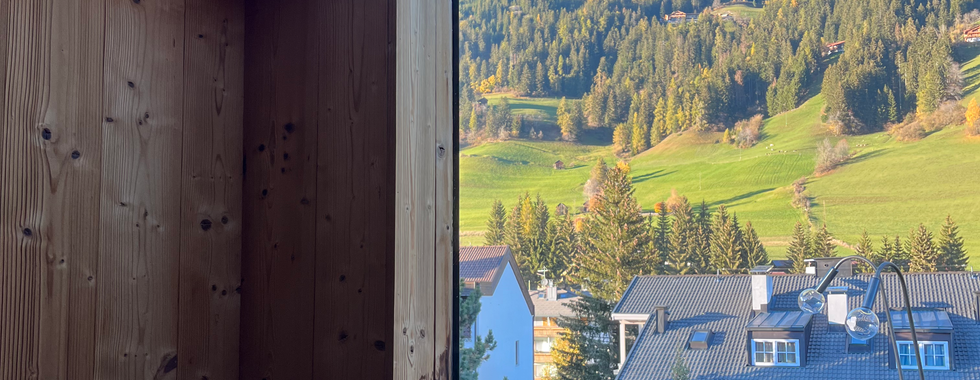
Difficult to explain in words, we want to give you some pictures:









Swimming:
For lovers of sport as well as wellness, San Candido offers various options: walks along the paths, skiing and winter sports, but also swimming in the Aquafun. Some hotels offer the possibility to enter even for free. Also recommended for families.
Other activities to do:
Paths through Tre Cime di Lavaredo (closed during winter period), buying typical food in the little shops around the main streets, hiking, trekking, sport, skiing in Baranci & visiting Christmas markets (winter period) and of course... eating typical dishes.
To EAT (where and what):
About restaurants, bars and nightlife you have to know that in San Candido you won't find many places to stay up late at night, as many bars close early. This place is designed above all to enjoy the landscape, nature and to practice sports during the day.
However, if you still want to look for some places, we suggest you visitthe main square and also move to thenearby towns to enjoy therestaurants, huts and shelters.
Trentino is famous for its typical dishes and wines (TrentoDoc, amongthe best known, but also Gewürztraminer and many other wines fromthe Pusteria and South Tyrol).
As typical dishes we undoubtedly suggest trying: the famous typical soups of South Tyrol, canederli (in broth or with butter accompanied by krauti), spatzle, the aforementioned local wines, a series of grappas (in these areas they really have many types , flavored in many flavors!) and of course, to conclude the meal, a piece of strudel for dessert.
For some typical restaurants, here are some that we want to suggest:
Enjoy your journey and stay tuned for more Italian winter escapes.. other news about Trentino-Alto Adige are coming!
Photos and texts © Claudia Spinato, 2023.


Commenti